


Kyoto has a reputation as the most over-touristed city in Japan –
And that is pretty accurate.
However, Kyoto is not only the stunning and historic old capital of Japan –
It’s also a city full of surprises
Join us for our second time visiting Kyoto and we’ll show you some incredible places that are really unique and special –
As well as some places that you really could probably just skip on your visit!
Follow along on our visit with this video:
(Note: some of the following link are affiliate links – I may receive a small commission at no extra cost to you)
And if you’re currently planning a trip to Kyoto, here are my most recommended tours
*************************
If you’re new to my blog and my channel, I’m Amalia – I’m a health coach, flight attendant and travel YouTuber
My husband and I’s first trip to Japan was 10 years ago, a year before our daughter was born.
We had an absolutely magical stay in Kyoto, at a Ryokan, a traditional Japanese guest house.
And while it was incredible, I actually do not recommend staying in a Ryokan in Kyoto.
Ryokans are an incredible experience, but they make the most sense when you’ll be spending a lot of time there, as you’ll usually eat a leisurely breakfast and sometimes even dinner there as well. In a city with as much to see and do as there is in Kyoto, you’ll want to spend most of your time outside of your hotel.
But if you would like to hear about a full ryokan experience, do check out our video on Kinosaki onsen, an absolutely beautiful onsen town, linked below!
We actually stayed in two different hotels in Kyoto –
One of which I definitely recommend and the other not so much – more on that later!
We had taken the Shinkansen from Tokyo and arrived at the very busy Kyoto station.
Unlike Tokyo, there’s not a huge subway system in Kyoto and so we took a taxi to our first hotel.
The Imu Hotel is a small but lovely boutique hotel in a great location.
The hotel is just a 10 minute walk from the Nishiki Market and even more interestingly – it’s right near a very old Shinto shrine called the Hanjo shrine.
The Hanjo shrine, otherwise known as the Hanjo-jinja shrine, dates back from the Heian period in the 8th century. This shrine is known for granting good luck and prosperity in business.
We stayed in a Japanese-style room at the hotel, which was perfect for us. This room gave us a lot of space since the futons that you’ll sleep on at night are folded and put off to the side during the day, leaving lots of space to lounge on the tatami mat. However, this hotel does have western style rooms available as well.
We found this room to be small – which is typical in Japanese hotels – but, very well designed!
*************************
Next, we headed out for a special meal. Today was my birthday and we had reservations for an Omakase dinner.
The restaurant was called Sushi Dokoro Ima.
It’s a bit outside of the city center but well worth it.
This is a very small, traditional restaurant where you sit on the floor on tatami mats, although there are a few seats at the bar as well.
We were brought course after course of equisite small dishes
If you’re new to Omakase, it’s a curated, seasonal dining experience, consisting of many small and carefully crafted courses.
We also tried this delicious Japanese luxury beer called Rococo. It was honestly amazing and tasted closer to a champagne than a beer!
We finished with this delicately prepared cheesecake that came with fresh fruit. Keep in mind that fruit is quite a luxury in Japan!
This meal was really quite affordable, considering the quality and the amount of food they serve. It came out to less than $150 total, including drinks, which is incredible for Omakase!
The next morning, we grabbed coffee downstairs and headed out for breakfast. Our hotel actually did offer breakfast, including some interesting gluten-free and even vegan options but we really wanted it to be out and about.
It was raining outside, but that wasn’t going to stop us!
We found a cute café nearby called Nicolla, which specialized in gluten-free dishes, which can be surprisingly difficult to find in Japan.
I generally eat gluten-free due to my autoimmune condition, although I honestly in Japan wasn’t always perfect about it.
But we enjoyed the laidback ambience of Nicolla, their Thai curry and their gluten-free desserts. I also loved their creamy Matcha. Kyoto is especially known for great matcha, as the city of Uji – on the outskirts of Kyoto – is famous for its quality Matcha production.
************
Next, we headed out to the famous Nishiki market.
The Nishiki market is a covered market that is over 400 years old – however, its origins go back as early as the 8th century!
So pretty much every tourist guide and video will tell you that you absolutely must see the Nishiki market. I have mixed feelings about this.
On one hand, it is a lot of fun to walk through and see all the different stalls with food, spices, teas, chopsticks holders, clothes, jewelry, hair ornaments, you name it!
On the other hand, it does feel extremely catered to tourists and it gets incredibly crowded.
If you have a very short stay in Kyoto, I would say that you can easily skip this. But if you have the time and you want a lively, one stop shop to get some souvenirs to take home or to just take in the vibe, then I would say it’s worth it.
We did really enjoy this spice shop that had lots of free samples and we did even take home a few bags of this seasoning, which is actually pretty yummy.
I would say most of the food we tried at Nishiki market was quite overpriced or forgettable, especially when you consider how much amazing food is available in Kyoto.
But we did really enjoy this stall that specialized in grilled oysters. Not only were they delicious but it was one of the few places we found that actually had some comfortable seating.
After the market, we headed back to the Shinkansen for a quick trip to Kinosaki Onsen, an hour and a half away. Definitely check out our full video on Kinosaki, because it’s a place that is definitely worth your time!
But we would be heading back to Kyoto two days later, so we left most of our luggage in the convenient locker in Kyoto station.
*********************
As a side note – when taking the Shinkansen in Japan, do make sure to pick up a few bento lunch boxes in the train station to enjoy for your trip. There are so many options to choose from and you can really have an excellent and economical lunch as you watch the scenery go by.
***
Two days later, we were back in Kyoto! We picked up our luggage and headed to our next hotel,
The Travelodge Kyoto Shijo Omiya
The Travelodge has a really lovely lobby with lots of space to sit, but the rooms…
Are another story. They are seriously tiny.
It kind of felt like a small child’s room. This backdrop on the wall was pretty cool though
It was late when we arrived so we headed to a nearby grocery store to pick up dinner.
I had read that you could get amazing deals on fresh sushi at Japanese grocery stores after 7pm.
And this proved to be absolutely true!
We got ourselves tons of sushi and chirashi bowls – and I even found a great deal on my favorite fruit, fresh figs!
Back at our hotel, we enjoyed our little sushi feast in the lobby
******
The next morning we went out for okonomiyaki for breakfast (Restaurant name: Okonomiyaki wa Cocoyanen).
If you’re not familiar, okonomiyaki s a type of Japanese savory pancake mixed with shredded cabbage and various fillings like pork, seafood, or cheese and cooked on a griddle. It’s usually topped with a savory sauce, Japanese mayo, dried seaweed flakes and bonito flakes – it’s absolutely delicious!
We got ours filled with oysters and it was incredible!
We washed it down with a refreshing and lightly alcoholic drink called a yuzu highball – what a great start to the morning!
*******
Next, we headed to Shijo Dori.
Shijo Dori, which means Shijo street, is an incredibly long street in downtown Kyoto that is known for shopping.
Is it touristy? Yeah, it can be, and unfortunately some tourists have created a lot of trouble in recent years –
But there are also quite a lot of gems here and it’s well worth your time.
For one, there’s the stunning view of the Kamo river
And another great reason is that it is right in the center of Gion, which is the traditional geisha district of Kyoto – more on that soon.
We enjoyed our walk on Shijo street and re-visited two places that we loved on our first trip here.
The first was Eirakuya.
Eirakuya was established in the year 1615 and this 400 year-old company is known for creating beautiful painted cloths called tenegui –
Tenugui can be used in all different types of designs, including bags, scarves, and framed wall hangings. They make amazing gifts and Eirakuya has really beautiful designs.
We were excited to see that a wall hanging that we brought on our previous trip and still hangs in our house, was still displayed in the shop
Our next stop was a place called Gion Koishi. Gion Koishi is an elegant store and café that sells Japanese sweets and delicious ice cream parfaits. These ice cream parfaits are so good and way better than the ones you’ll find at the Nishiki market. They even serve you complementary Genmaicha tea, which is such a nice touch.
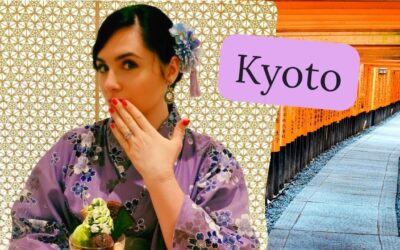
Being here brought back memories from our last visit and – yes, that’s me dressed in kimono 10 years ago!
And by the way, if you’d like to dress in kimono while you’re in Kyoto, Shijo street is definitely the place for that. There are tons of shops here that are specifically catered to helping tourists dress in kimono for the day. Many of them will even do your hair as well!
We continued our walk to Motoyoshicho, a beautiful and historic area in the heart of Gion, which is a popular area for sighting geisha.
A quick word about geisha –
If there’s a symbol that defines the city of Kyoto, it is definitely the image of the geisha. You’ll see representations of geisha absolutely everywhere throughout the city, even on vending machines!
However, actually spotting geisha in real life is almost like spotting a celebrity. And they truly are the celebrities of Japan, especially in Kyoto. And if you’re lucky enough to see a geisha, definitely keep a respectful distance.
No – they will not pose for selfies with you.
Both geisha and apprentice geisha, known as maiko, go through years of intensive training in the traditional performing arts.
Unlike some popular representations, geisha are not high class call girls. They are highly trained artists and performers who are primarily hired by high ranking executives and politicians in Japan for private events.
Back to Motoyoshicho –
We finished our walk and returned to our hotel for a quick nap.
A short while later, we headed back out to see the famous Fushimi Inari shrine.
There are so many incredible shrines and temples to see in Kyoto and you definitely can’t see them all in just a few days.
We had miss seeing Fushimi Inari on our previous trip and we had read that after sunset was the best time to see it.
And this was definitely true.
With a full moon in the sky and the dim light of twilight, Fushimi Inari shined its lights even brighter.
The Fushimi Inari shrine dates back to the year 711 and some believe it might’ve been built even earlier than that.
The shrine is dedicated to a Shinto deity called Inari Okami, the deity for foxes – which are believed to be messengers of G-d, fertility, rice, tea and sake, and prosperity and success.
There is something truly magical about this place, and we spent quite a while wandering around.
Another plus of visiting this shrine at night is that while there were plenty of other people, it really didn’t feel crowded at all.
The most famous part of the Fushimi Inari shrine is the tunnel of vibrant red torii gates known as Senbon Torii, which means 1000 gates – although there are quite a lot more than 1000.
Companies and individuals from all over Japan dedicate torii gates to shrines because of their legendary divine properties for prosperity in business and every Torii gate has the name of its donor written on it.
Walking through the gates is quite an experience – and doing it at night really adds to its mystery and fascination.
By the time we left, we were starving and so we headed back to Gion to explore Pontocho Alley.
Pontocho Alley is a historic stretch of narrow streets lit by lanterns. It is quaint and beautiful. And sadly, overrun by tourists.
I definitely do recommend going for a walk there, especially at night, when it’s especially beautiful. But do be prepared that there will be crowds.
I wouldn’t necessarily recommend eating dinner there, unless you have a personal recommendation for a specific place. Most of the restaurants in Pontocho are either incredibly touristy – or totally disinterested in having any tourist dining there.
So we wandered back to nearby Motoyoshicho and discovered a gem of a restaurant in a beautiful old building.
Gion Katana is an elegant yakitori restaurant. Yakitori are grilled chicken skewers and that is the specialty of this place. Despite not having reservations, we were graciously shown to a beautiful private room that made us kind of feel like royalty.
We were offered a menu with different variations of yakitori Omakase. We enjoyed several different and surprising courses, elegantly served in this lovely room that we had all to ourselves, with soft jazz playing in the background. We finished with a light dessert and hojicha tea that they brought to our table.
This is such a special place to enjoy and while it’s a bit upscale, the prices were still pretty reasonable.
*****
Sadly, the next morning it was time for us to return to Tokyo, as we would be leaving Japan in the next few days.
If you haven’t seen our Tokyo video yet, definitely check that out for a full off the beaten path itinerary. You can also check out our full Japan playlist for all the amazing places we experienced on this trip.
Kyoto is such a special, beautiful and incredibly historic city. This is definitely the city to go to to learn about the traditional side of Japan.
Yes, you should expect some crowds in the most famous places, but honestly, there’s so much more to this city than just the standard itinerary. Overtourism or not, Kyoto is definitely not to be missed on a visit to Japan!
***********************
What I do highly recommend for your first visit to Kyoto is taking a tour to maximize your time, a private or small group tour if possible. There are just so many incredible things to see in Kyoto and believe me, these attractions can be quite far apart from one another!
Here are my top recommended tours of Kyoto
Thank you so much for joining us for this experience. If you enjoy the linked video, please consider giving us a like and subscribing if you’d like to see more travel adventures and wellness.

0 Comments